Friday, December 3, 2010

Making pumpkin pie for Rotary

Since we couldn't be home for Thanksgiving this year, Michael and I decided to bring the Thanksgiving tradition to Ireland.  We started by making a pumpkin pie for the Dublin Central Rotary Club.  (I've found that while most Irish people I've spoken to have had turkey, dressing, mashed potatoes, gravy, etc., very few have ever tried pumpkin pie.)  It was very sad to cut up the pumpkins we painted for Halloween, but after the pie was finished, it was definitely worth it.  This is how we did it:

We started by cutting the pumpkin into chunks and cutting off the stringy inside part.  If you've never cut up a pumpkin before, think of it as a cantaloupe.  When you slice it, you have to make sure you cut off the part with the seeds before you serve it; it's the same case here.  At this point you can cut off the skin as well, though I find it's much easier to wait until after you cook them. 

Next, boil the pumpkin until it's soft, just as you would if you were making mashed potatoes.  You know they are done when you can easily put a fork into the pieces (though the skin will never be that soft).  The longer you cook the pumpkin, the more "meaty" it will become.  It just depends on how you want your pumpkin pie to taste.  The size of the chunks also depends on how long you will need to boil them.  Again, the same as if you were making mashed potatoes.

Chances are, you won't be able to fit all the pieces into your pot.  For our small pumpkin it took 5 times, so Michael and I had some candy corn his grandmother and my aunt sent over in a package.  (They don't sell it over here.)  It helped get us in the Thanksgiving mood while we waited for the pumpkin to boil.

I also set aside the seeds.  When I was a little girl, my mom would always bake the pumpkin seeds while my dad handled the dangerous carving before Bradley and I were old enough to be able to use knives.  We loved them when we were kids, so I washed them and set them aside to cook for later.  (I made them with 1 tablespoon of butter, salt, and pepper, and cooked them at 150°C / 300°F for about 25 minutes - they were delicious.)


Once the pumpkin is tender, set it aside to cool for about 10 minutes or until you can comfortably hold it.  The skin should peal off easily with a knife.  Discard the skin and put the pealed, boiled pumpkin into a bowl to be mashed.  Don't worry if the pumpkin seems much more watery than the pumpkin you normally use from a can; it should be.  Most recipes that call for pumpkin will require you to heat it up before using it anyway, so you can cook out the excess water.  If you don't plan on heating the pumpkin, you can freeze and then thaw it.  It will help to separate out some of the water, though not all.  You can also purchase cheese cloth and strain the pumpkin through that.  I wasn't that picky and we had to cook the pumpkin for pie anyway, so we didn't worry about the extra water.

After Michael mashed up the pumpkin, we had more than enough to make the pie.  We followed a basic recipe, though we had to substitute often for ingredients that were hard to find or too expensive.  (Sorry cloves and ginger, we would never use you again.)

I took the pie to the Rotary meeting the day before Thanksgiving.  Despite initial reluctance to try it (they thought the idea of making a dessert out of a gourd sounded gross), a few brave Rotarians had a piece, and with their endorsement the rest joined in.  It was a success!  I had made enough pie for each Rotarian to have 2 pieces, though I assumed most would only have one.  I planned on taking the rest to a Thanksgiving party the next day, but by the end of the meeting there were only a few small pieces left.  Luckily, the small pumpkin made enough for 2.5 large jars even after I made the pie, so I think we'll have enough to make some more.

Here is the general recipe I used, though I just eyeballed most of the measurements:


2 cups of pumpkin
1/4 cup brown sugar
1/2 cup sugar
1 cup cream
1/2 can of evaporated milk (85 g)
1/2 can of condensed milk (200g)
1.5 teaspoons ground cinnamon
1.5 teaspoons ground nutmeg
2 eggs
1 egg yolk

I also added 5 oz of cream cheese that I had in the refrigerator and didn't know what else to do with. 

For the crust, we crushed up plain digestives until they filled the bottom of the pan and added about half a cup of butter, a little cinnamon, nutmeg, and brown sugar, and baked it until it turned brown.  For the filling, I heated the pumpkin and sugars on the stove, then mixed the rest of the ingredients separately while the water evaporated out of the pumpkin.  Once it was ready, I poured the pumpkin/sugar mixture into the mixing bowl and stirred before adding it to the crust. 

Friday, November 12, 2010

Rotary presentation at Dublin Central

Wednesday evening I was finally able to give my presentation at Dublin Central Rotary Club, my host club here in Ireland.  I usually have class on Wednesday nights and come late to the meetings, but this week class was canceled and I was able to give my presentation.

The presentation itself has 4 main parts: information about the scholarship, information about me, information about Kentucky, and information about my host club back home in Murray.  Although I have presented twice before, this was the first opportunity I had to go through the entire presentation.  The two other clubs gave me a 5-7 minute window and I just had to hit the highlights.  It was also my first opportunity to use a projector and include photos with the presentation.  It made a huge difference.

The Dublin Central club was most interested in two aspects of my speech.  First, they were intrigued by the idea of me being in a sorority, as they don't have Greek organizations in Ireland.  They wanted to know what my letters, Sigma Sigma Sigma, stood for and all about the secrets that go along with being in a sorority.  Although I told them about our open motto and our philanthropy, they didn't understand that I couldn't reveal the organization's secrets unless they were members too.  My club was also intrigued by the philanthropic aspect of Greek life, as that seems to have fallen by the wayside in the pop culture idea of fraternities and sororities.  The fact that I had lived in a sorority house was quite exciting for them as well, and after the meeting I had several members who wanted to know if it was like the movies.

Secondly, (and by far the most successful part of the presentation) was my local club's fundraiser "Kiss a Pig Contest."  Rotary members can be nominated for $5 and are charged with raising $100 by the Christmas parade.  The Rotarian with the most money "wins" and gets to / has to kiss a pig at the parade.  Luckily, I had a photo of Roger Reichmuth from last year's contest kissing Pork Chop and it caused quite a bit of excitement.  The club was very surprised and wanted to know if the pig was real, if the pig was alive, where it came from, etc.  They were quite impressed that Roger was willing to kiss it, even for the sake of raising money.  One gentleman commented, "Those Rotarians in Kentucky must be really dedicated to eradicating polio!"

For more information on the "Kiss a Pig Contest," see the Murray Rotary Club's website: http://murrayrotary.org/portal/index.php?option=com_content&view=article&id=103%3Akiss-a-pig-contest&catid=43%3Aactivities&Itemid=1

Friday, November 5, 2010

Student Protests in Dublin

Education not Emigration

The Union of Students in Ireland marched on Leinster House (the parliament building), Wednesday, November 3rd, to protest the potential doubling of undergraduate registration fees and possible cuts to maintenance grants in the upcoming year.


25,000 students from universities nation-wide showed up to march in Dublin.  The demonstration began at Parnell Square and went through the city center, ending at the parliament building.  During the two mile walk, protesters chanted continuously.


Although the protests were intended to be peaceful, a group of 2,000 is reported by the Irish Times to have broken off from the main group after the demonstration and continued the protest outside the Department of Finance Building.  Students are reported to have thrown bricks, eggs and placards, and 20 students were able to get inside the building itself.

There were some injuries reported, but no one was seriously hurt.

For more information concerning the clashes on Wednesday, see the Irish Times article http://www.irishtimes.com/newspaper/breaking/2010/1103/breaking20.html


Background:


Currently, the Irish government pays for students from the European Union to attend university.  While tuition is free, students still must pay a registration fee that covers "the costs associated with registration, examinations and student services," according to www.educationireland.ie.  (One of my classmates informed me that student services includes student insurance, health care on campus, etc.)

While paying €1,500 or even €3,000 may not seem like much for a college education, it's important to note that the fee jumped from €900 to €1,500 for the 2009/2010 school year.  If it jumps again for the 2011/2012 year it will mean a 233% increase in just two years.  Irish families who have been budgeting for the lower registration fees may not be able to come up with the extra funds - especially if they have more than one child.

The government has also proposed a 10% cut to the maintenance grant, given to students from disadvantaged backgrounds to help offset the cost of student fees and other financial requirements.  While the grant may be as much as €6,000, it is typically between €1,000 and €3,000.  According to the Bank of Ireland, the minimum cost of living for a college student is €10,500 (I don't know where they're getting their numbers, because that wouldn't even cover housing in Dublin).  Thus, students who have the grants are still having to take on jobs to offset the cost of living.  Additional cuts would add further financial strain.

Because of the recent economic downturn, it is almost impossible to get a job in Ireland without a college degree.  Students fear that if they are not able to afford an education, they will be unable to find work in their own country.

For more information see the official Education not Emigration website: http://www.educationnotemigration.ie/wp/

Tuesday, November 2, 2010

Visiting the Oldest Rotary Club in Europe

On Monday I went to speak at the Rotary Club of Dublin.  (I was lucky all the green face paint came off from Halloween party the night before when I had dressed up as a witch - though I'm sure my speech would have been all the more memorable for it.)

The Rotary Club of Dublin meets in The Grand Canal Hotel in Ballsbridge Dublin 4 every Monday between 12:45 and 2:00 pm.  Apart from the usual fundraisers and charity events, the club is most proud of its legacy as the oldest Rotary Club in Europe.  This year marks their 100th birthday, and the centenary was quickly picked up as the theme for the Rotary District 1160 Annual Conference "Celebrating 100 Years of Rotary in Ireland."


One Rotarian informed me that The Rotary Club of London was chartered the same year, but as the Dublin's club began just a few months before the London club, it causes quite a bit of frustration for "those Brits." 

I enjoyed speaking to the club, exchanging flags, and meeting the Rotarians.  I even got to sing "Happy Birthday" to a member of the club, who turned 80 and couldn't have been happier about getting an entire chocolate cake to himself for the occasion. 

For more information about the club, visit their website at http://www.rotary-ribi.org/clubs/homepage.asp?ClubID=969

Sunday, October 31, 2010

Painting Pumpkins

Several weeks ago, I attended the Rotary District 1160 Annual Conference.  Every Ambassadorial Scholar in Ireland attended and I met quote a few incoming and outgoing scholars who lived in or near Dublin.  Although all the scholars were fantastic, I was thrilled to learn that Emily, the girl with whom I had most in common, lived in Dublin.  We also had the opportunity to meet Emma, an Irish outgoing scholar for the 2011-2012 year.  Both Emily and Emma attend University College, Dublin (UCD) and since we all hit it off, we decided to get together to celebrate Halloween.

Pumpkins aren't a huge part of the Halloween festivities in Ireland.  In fact, my classmates tell me that it's only been in the past 5 years that you could even buy them.  Because of this, Emma had never carved or painted a pumpkin before.

Because no Irish recipes call for pumpkin, it is impossible to buy canned pumpkin in Ireland.  Thus, as Michael and I want to have pumpkin pie (enough to share) for Thanksgiving, we decided to only paint our pumpkins so they would last longer before we had to cut them up and freeze them.  We did enjoy explaining to Emma the most important things to know about carving a pumpkin (making sure the lid is at an angle, the best recipes for cooking the pumpkin seeds, the secret of tracing complicated designs from computer paper, etc.)  I love teaching people new things, and she was very enthusiastic to learn about American Halloween traditions.

We wanted to know all about Irish traditions as well.  Emma told us that in Ireland, fireworks are a big part of Halloween.  Bonfires are also associated with the holiday.  In fact, there was quite a controversy a few years ago when city counsels began banning bonfires for health and safety reasons.   Citizens felt as though part of their culture was being taken away.  It's still a little controversial, though less so now that people are more used to it.  The Irish Times even reported that the South Dublin County Counsel is giving out daffodil bulbs to communities that prevent bonfires in locations where there were fires last year.  http://www.irishtimes.com/newspaper/frontpage/2010/1018/1224281343590.html

Since we couldn't enjoy Irish bonfires, we enjoyed American pumpkin painting.  Emma, quite the artist, made a cute pumpkin with a half smile.  Michael made a scary clown pumpkin.  I tried to make Edgar Allan Poe on my pumpkin, but I thought the result looked more like Salvador DalĂ­.  Emily, more of a scrapbooking fan, worked on her book.


After a successful day of pumpkin painting, we took a tour of UCD's campus while the pumpkins dried.  One of the highlights was seeing the tree Bill Clinton planted during his visit on September 30th for the opening of the UCD Clinton Institute for American Studies.  For security reasons, none of us had been allowed to see Clinton actually plant the tree, but it was still nice to see it afterward.  http://www.ucdclinton.ie/events_conferences_2010_clinton.htm
 
After our pumpkins were dry, we carried them home on the bus and I began cutting our third, unpainted pumpkin up to boil, mash, and freeze (so the liquid separates out) for pie next week.  Had we been at home in Murray, we would have spent the rest of the evening in the Curris Center ballroom participating in Rocky Horror festivities.  The tickets here were €15 a person ($20) and we just couldn't justify spending so much money.  As it turned out, Michael surprised me by bringing a copy of the movie to Ireland on his computer and just as we were beginning to watch it, Emily called to say she was in city center and was wondering what we were doing.  She ended up coming up to the apartment, having some pumpkin seeds and diet coke, watching Rocky Horror (a first for her), and doing the Time Warp until we were exhausted.  All in all it was a great way to spend our first Halloween away from home.

Tuesday, October 26, 2010

Monster Class

To fulfill my options requirement for popular literature this semester, I am taking a class entitled "The Monster Show" taught by visiting lecturer and well-known film historian David J. Skal.  We are learning quite a lot about the first horror films that terrified audiences: The Cabinet of Dr. Caligari, Nosferatu, Dracula, Frankenstein, etc. The class itself is fantastic, but it's all very intellectual; with the textual analysis and the comparison to the films, there's not a lot of time to squeeze in humorous interpretations.  So, our "Monster Class" decided to take matters into our own hands and to host our own screenings of films a little more light-hearted.  With Halloween coming up, it wasn't difficult to get our hands on a copy of Mel Brooks's "Young Frankenstein," and, as one of our classmates has an HD television, we determined to have a class (plus spouses) get-together / viewing.


The evening also turned into a sort of cultural exchange, as we all brought snack food to share.  We "foreigners" brought some of our American / Canadian food (microwave popcorn, pumpkin bread, Cheetoes) and the European students brought Irish / British food we can't get back home (a sort of raw veggie dip similar to ranch, various European chocolates, etc.)  In the upcoming weeks - time permitting - we hope to make the "fun" film screenings a regular thing.  Perhaps Rocky Horror or some of the more campy horror films will be added to the list.

On a side note, our class also decided to celebrate the lecture before Halloween by wearing plastic fangs to class.  Since Skal is most well known for his research on Dracula films we thought he would feel right at home.

Saturday, October 23, 2010

Exploring Howth

About two weeks after arriving in Dublin, my host Rotary Counselor invited my husband and me to dinner at her home.  She lived just northeast of the city (about 9.5 miles) in the suburb of Howth (rhymes with "both").

Although we didn't get to see much of the town during our visit, the area was highly recommended for hiking, so Michael and I decided to go back one weekend and explore.  Thus, this afternoon we boarded the DART (Irish Rail) and set off once again for Howth. 

Howth is a peninsula that juts out just north of Dublin Bay.  It's still in County Dublin, though it has a completely different atmosphere.  The port town harbor was full of both sail boats and fishing boats when we arrived.
The first thing we did was stop by the harbor to feed the seals that beg for fishing scraps.  They were in a great mood and, as a little boy was throwing fish to them, they put on quite a show.  Afterward, we visited the lighthouse and watched the sailboats go by.  It was beautiful, but despite the bright sun, it was very cold.  Michael and I walked around a bit, then decided head up to the shoreline cliffs to begin our hike and (hopefully) warm up a bit.


The cliffs offered 4 different trails: 6 km, 7 km, 8 km, and 10 km.  As they all started out on the same path, we decided to see how things went before determining the trail.  We took our time getting to the trail head and enjoyed the view as we walked up the path that lead to the cliffs.


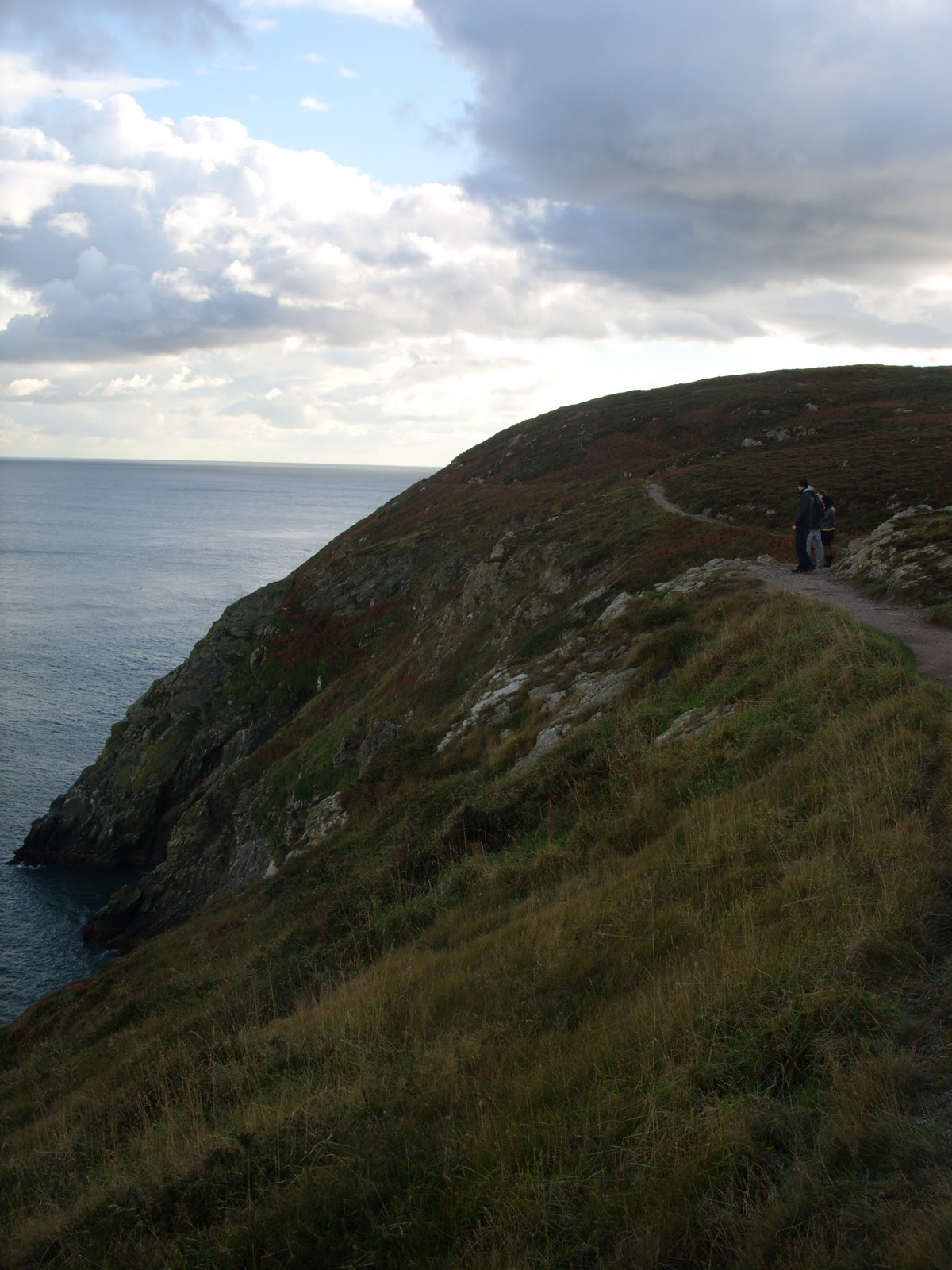
Despite the steady climb, the trail wasn't bad at all, and the scenery was breathtaking.  We could see ships far out to sea, and the birds flying below us looked so far away.  (At one point, we even saw some blackberries growing along the side of the cliff and stopped for a little snack.) 

Just before we reached the summit, the clear skies turned cloudy, and it began to rain.  Despite being cold and wet, it was quite beautiful to be able to see the dark clouds right above us and the sun shining behind the clouds farther out to sea.  (If you look closely at the photo, you can see a lighthouse on the very edge of the land.  That will give you an idea of just how small everything seemed from that height.)


Having already passed the 6 km and 7 km trails, we decided to take the 8 km path instead of going on for the full 10 km.  We headed off the cliff trail and hiked into the interior of the peninsula.  At times we found ourselves walking through dense, wooded areas.  It was much less scenic, with one exception.  At one point, the trail took us through a grove of birch trees whose yellow leaves had covered the path.  It was so beautiful, especially since the rain let up for a bit just as we were coming into it, that it was well worth hiking through all the mud to see it.

We eventually made it back to civilization after approximately 3 hours, and it even stopped raining toward the end.  Overall it was a great day - especially when we celebrated our victorious athletic endeavor with some well-deserved ice cream!